

A Networked Virtual Tabletop For TTRPGs, with Social Presence Driven Communication Design.
VTT/53 is the software artefact I developed as part of my Honours Research Project during my final year of study at Abertay University. It was developed in Unreal Engine 5.3 using the Agora Video Call Plugin. It’s a virtual tabletop built to test the effects of changing the format of video calls on players feelings of social presence, and how that affects their overall gameplay experience.
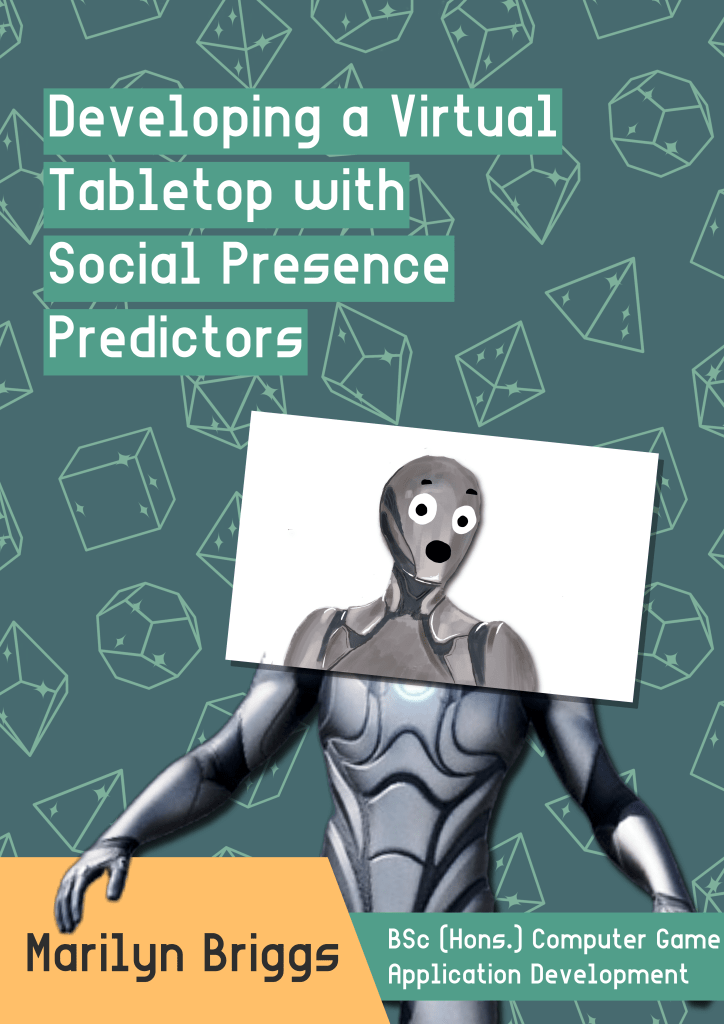
VTT/53’s main feature is the way it integrates the video call communication aspect of online gaming into the virtual tabletop software, placing players video feeds directly in front of their avatars heads. This is to better replicate the feeling of an in person session.

I’ve spent a lot of time playing TTRPGs online during the last 6 years, and have always noticed a feeling of something being missing in these online, digitally mediated, interactions. Current software solutions for online communications, such as Teams or Zoom, often display the same shortcomings. Users describe feeling disconnected at times from the other people in the call, they struggle with non-verbal communication such as mutual gaze or conversational gesturing, And when they are communicating verbally, they run into issues with turn-taking cues and all the audio streams having equal volume and priority.
All this this leads to cross-talk, low attention levels, and overall for TTRPGs, a worse gameplay experience.
How can we develop software that solves these problems? That was the question that drove the design and Development of VTT/53, and it was the question that lead me to the research field of Social Presence.
What Is Social Presence?
Social Presence has been defined many ways, but I feel that Biocca, Harms & Burgoon’s provisional description at the start of their 2003 paper, “Towards A More Robust Theory and Measure of Social Presence: Review and Suggested Criteria” , is a fairly good jumping off point:
Social presence is the “sense of being with another”.
This other could be another person, it could be an artificial intelligence. The important part is that there is a feeling of mutual awareness, a feeling that the other entity is a full, sentient being.
Its a term often used in digital communication research, or any research into mediated communication. The gold standard of social presence, i.e. the communication method that generally invokes the strongest feelings of social presence, is face to face communication. Over thousands of years, humans have evolved to communicate like this, building meaning into every part of an interaction, from the words said, to how they were said, to the motions and gestures made while saying them, to how the person saying them looks and stands and presents themself.

 Marilyn Briggs | Game Developer